GENFIN Business Finance is built for momentum—short-term, flexible funding that helps South African SMEs move quickly when stock, supplier discounts, or growth opportunities can’t wait. In this review, GENFIN Business Finance is unpacked end to end: how it works, what it costs, where it fits, and how it compares to other funders. Expect practical guidance, clean tables, and step-by-step tips to help you decide with confidence.
Business Funding



Whether your business is chasing seasonal stock opportunities, bridging supplier gaps, or scaling operations to meet new demand, GENFIN provides the speed and flexibility traditional banks often can’t. Its simple application process, rapid approvals, and transparent pricing model make it a go-to option for entrepreneurs who want to stay ahead of cash-flow challenges without being weighed down by red tape.
Overview
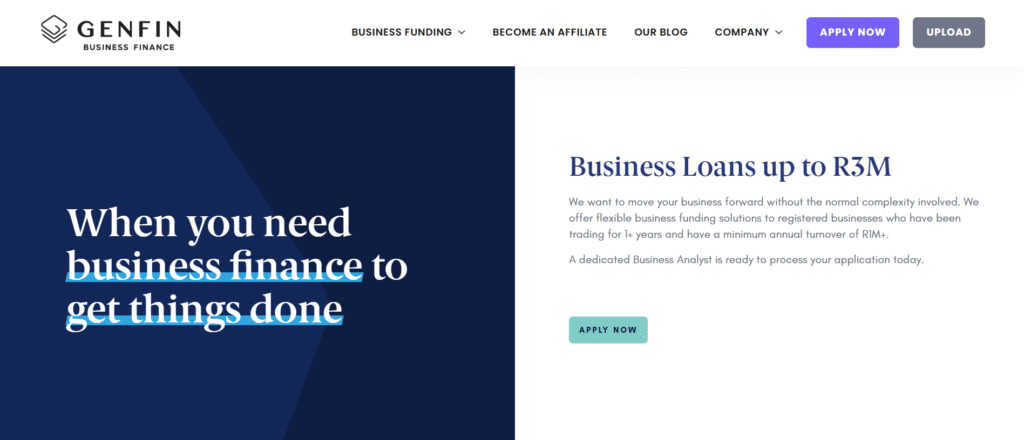
GENFIN Business Finance focuses on working-capital solutions designed around real-world cash flow. It prioritises a quick application, fast decisions, and repayment structures that sync with trading rhythm rather than rigid, long bank loans. That makes it well-suited to inventory cycles, bridging purchase orders, smoothing receivables, or grabbing early-payment discounts from suppliers.
What stands out: short to medium terms, clear total payback visibility, and streamlined onboarding. It’s not a tool for buying buildings or heavy machinery; it’s a tactical facility for near-term ROI.
How GENFIN Business Finance Works
Underwriting centres on affordability and trading performance. After a concise online application (business details + bank statements), underwriting assesses turnover stability, cash-flow behaviour, and risk. If approved, the business receives a lump sum and repays over a short term via fixed instalments (and in some cases, flexible structures that track revenue pattern).
Typical flow:
Apply online → share statements → affordability check → offer (amount, term, total payback) → payout → automated repayments until settled.
Product Line-Up (What You Can Get)
- Working Capital Advance: A lump sum with a fixed cost and a clear schedule, ideal for stock and short-term liquidity gaps.
- Turnover-Friendly Options: Repayment patterns that align to sales rhythms, easing pressure in quieter weeks.
- Bridging/Stock Use Cases: Purpose-built for purchase orders, seasonal ramps, and supplier discounts.
Indicative envelope: from smaller tickets suited to micro-SMEs up to substantial amounts for established firms; terms that generally span weeks to low double-digit months.
Eligibility & Documents
GENFIN Business Finance serves actively trading South African businesses.
Common signals of fit:
- Registered SA entity with an active business bank account
- Trading history (generally several months or more) and consistent turnover
- 3–6 months of bank statements, standard KYC/ID docs
- A clear, ROI-positive use case (stock, bridging, discount capture)
Pricing & Fee Structure (Expanded)
GENFIN Business Finance typically uses transparent, fixed-fee or factor-style pricing rather than variable interest. You see your total payback upfront, which simplifies planning and prevents surprises. Because terms are short, the effective annual cost can appear higher when annualised; the better lens is margin impact per cycle.
Before the table:
- Match the term to your cash cycle (inventory, receivables, project milestones).
- Confirm early-settlement rules in writing.
- Model repayments against conservative revenue to avoid squeezes.
| Loan Amount (Illustrative) | Typical Term | Repayment Style | Indicative Fixed Fee Range | Estimated Total Payback | Early Settlement |
|---|---|---|---|---|---|
| R50,000 – R250,000 | 6–12 weeks | Weekly/Daily | ~8% – 18% | R54,000 – R295,000 | Often available (ask) |
| R250,000 – R1,000,000 | 3–6 months | Weekly | ~10% – 22% | R275,000 – R1,220,000 | Discount possible (case-by-case) |
| R1,000,000 – R3,000,000+ | 6–12 months | Weekly/Monthly | ~12% – 26% | R1,120,000 – R3,780,000 | Negotiable; confirm upfront |
How to read this: the shorter the term, the faster the capital cycles—and the more important it is that your margin comfortably exceeds the fee. If a supplier’s 3–5% discount plus faster sell-through beats the finance cost, the facility is doing its job.
Owner’s quick checklist:
- Use funds only where ROI is near-certain (proven SKUs, confirmed POs).
- Keep a buffer for slow weeks.
- Re-advance only after the first cycle proves the maths.
Funding Speed, Amounts & Repayments
- Speed: Decisions and payouts aim to be fast once documents are complete.
- Amounts: From modest working capital to multi-million rand facilities for qualified SMEs.
- Terms & Repayments: Weeks to low double-digit months; fixed instalments or revenue-friendly patterns.
Advantages
- Speed & simplicity for time-sensitive opportunities
- Transparent total payback (easy to plan)
- Cash-flow-aligned repayments reduce stress in quiet periods
- Short cycles enable multiple inventory turns per year
- Unsecured options common for qualifying SMEs
Disadvantages
- Higher effective annual cost than long, secured bank loans
- Short terms require disciplined, ROI-led deployment
- Frequent deductions demand tight cash-flow management
- Turnover volatility can limit available amounts
Safety & Legitimacy
GENFIN Business Finance operates as a recognised alternative funder in South Africa’s SME landscape. Standard best practices still apply: verify contract terms, confirm any origination/admin fees, clarify early-settlement adjustments, and keep internal comparisons of multiple quotes.
Who GENFIN Business Finance Is Best For
- Retailers & hospitality with predictable sales cycles
- Wholesalers & distributors turning inventory within 30–90 days
- Seasonal businesses needing capital to ride peak periods
- Growth-phase SMEs bridging larger orders or unlocking supplier discounts
It’s less ideal for long-dated capex or very thin margins that cannot absorb short-term fees.
Step-by-Step: How to Apply (and Win Approval)
- Define the use case (stock, PO bridging, discount capture) and map ROI.
- Prepare documents: 3–6 months bank statements, CIPC + KYC, recent management figures if available.
- Model affordability against conservative revenue and low-season weeks.
- Apply online and respond quickly to info requests.
- Compare the offer: amount, term, total payback, repayment pattern, early-settlement rules.
- Deploy capital with discipline—track unit economics per SKU/order.
- Monitor cash flow and consider re-advancing only when the numbers are compelling.
Smart Cost Control (Without Killing Growth)
- Term vs instalment pressure: a slightly longer term can ease weekly cash strain.
- Supplier discounts: 2–5% early-payment incentives can offset funding cost.
- SKU discipline: channel funds into proven products and reliable buyers.
- Buffering: maintain a modest reserve for quieter trading stretches.
- No stacking: avoid piling on multiple short-term facilities.
Alternatives to Compare (SA Market)
GENFIN Business Finance competes in a crowded space. Which option wins depends on your priorities—speed, flexibility, or headline cost. The table below gives a practical snapshot; always compare live quotes.
Context before the table:
- Choose GENFIN Business Finance for speed, clarity, and cash-flow-aware schedules.
- Choose a revolving facility if you want ongoing access without reapplying.
- Choose a bank product if you qualify easily and can wait for cheaper, prime-linked pricing.
- Choose merchant-style advances if card turnover is your main inflow and you prefer turnover-linked deductions.
| Provider | Funding Type | Typical Term | Speed | Security | Indicative Cost Style | Best For |
|---|---|---|---|---|---|---|
| GENFIN Business Finance | Working Capital / Revenue-Friendly | 6 weeks – 12 months | Fast | Unsecured (qualifying) | Fixed fee/factor | Stock cycles, POs, seasonal ramps |
| Lula | Business Line of Credit | 1 – 12 months | 24–48h | Unsecured | Prime + margin | Flexible drawdowns over time |
| Bridgement | Revolving/Invoice-Linked | 1 – 12 months | ~24h | Unsecured | Flat monthly utilisation % | Invoice-heavy SMEs |
| Fundrr | Short-Term Loan | 3 – 9 months | 24–48h | Unsecured | Monthly factor | Digital-first SMEs |
| Merchant Capital | Merchant Cash Advance | 3 – 9 months | ~24h | Unsecured | Fixed fee, turnover-linked repay | Card-heavy retail/hospitality |
| Retail Capital (TymeBank) | Turnover-Based Funding | 3 – 12 months | 24–48h | Unsecured | Fixed fee with POS split | SMEs using POS systems |
| Banks (FNB/Absa/Nedbank/SB) | Term Loans/Overdrafts | 12 – 60 months | 1–4 weeks | Often secured | Prime-linked interest | Established firms with collateral |
After-table guidance:
If speed + clarity are paramount, GENFIN Business Finance is compelling. If ongoing access is crucial, consider a revolving facility. If lowest rate is your north star and you qualify seamlessly, banks usually win—though processes are slower and requirements stricter.
Use-Case Playbooks
Peak-Season Stock-Up: A retailer expects a holiday surge. A 12-week facility funds bestsellers at a supplier discount; the margin easily covers fees.
PO Bridging: A catering SME must pre-purchase bulk ingredients for a confirmed corporate order. A short facility bridges costs until client payment.
Receivables Gap: A wholesaler’s big buyer pays on 45 days; working capital keeps operations smooth without halting procurement.
Frequently Asked Questions
1) How fast can funding land?
Once documents are complete and affordability checks out, decisions and payouts aim to be fast.
2) What amounts and terms are common?
From modest working capital to multi-million rand facilities; terms typically range from a few weeks to around a year.
3) Do I need collateral?
Unsecured options are common for qualifying businesses; affordability still drives the final offer.
4) How are costs structured?
A fixed fee/factor defines total payback upfront—easier planning than variable interest.
5) Can repayments flex with my sales?
Yes—options that align to trading rhythms can ease pressure in slower weeks.
6) Which industries fit best?
Retail, hospitality, wholesale/distribution, and other short-cycle inventory operations.
7) What if my credit isn’t perfect?
Affordability and trading performance carry significant weight; sub-par credit isn’t an automatic decline.
8) What documents are required?
Typically 3–6 months bank statements, KYC/ID, CIPC proof, and sometimes recent management figures.
9) Can I settle early?
Early settlement is often available; ask about potential discounts before signing.
10) Are there hidden fees?
Total payback is presented upfront—still review contracts for admin or settlement terms.
11) Can I re-advance later?
Yes—many providers streamline top-ups once most of the balance is repaid and trading remains healthy.
12) How do frequent deductions affect cash flow?
Model repayments against conservative revenue; keep a small buffer.
13) Is this cheaper than a bank loan?
Typically not on an annualised basis; you’re paying for speed, flexibility, and ease.
14) Can I use the funds for anything?
Generally yes—stock, marketing, bridging orders, or working-capital smoothing.
15) What improves approval odds?
Stable turnover, clean statements, and a clear, ROI-positive use of funds.
Final Verdict

GENFIN Business Finance delivers what fast-moving SMEs need: speed, clarity, and cash-flow-friendly repayments. It’s strongest when used for short, high-ROI cycles—stock buys, supplier discounts, PO bridging—where the fee nests comfortably inside your margin. Compare live quotes, pressure-test affordability, and favour use cases with reliable turn. Used with discipline, GENFIN Business Finance can help an SME buy better, sell faster, and scale smarter—making GENFIN Business Finance a practical choice for FundingWay readers who value decisive execution.