TIA is the bridge between a promising concept and a market-ready product. It helps innovators turn ideas that simply work into solutions that sell. Whether you’re refining a prototype, scaling a pilot, or building your first plant, TIA provides the capital and technical backing to cross that critical gap.
Business Funding



For South African founders, researchers, and spin-outs, this support can be game-changing. TIA funds key development stages, offers expert guidance, and links innovators to partners and DFIs—creating a smooth path from invention to industry success.
Overview
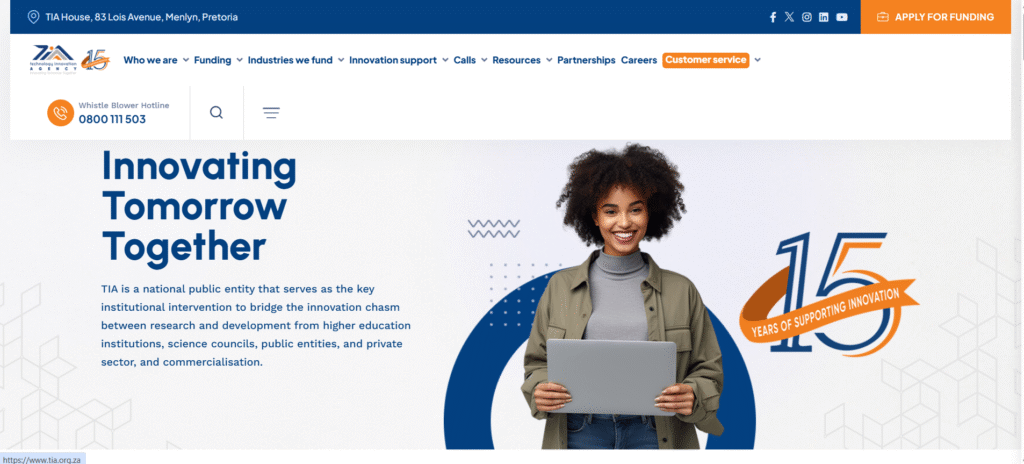
TIA (Technology Innovation Agency) supports South African innovation across the development lifecycle—proof-of-concept, prototyping, piloting, pre-commercial scale, and market entry. Unlike pure lenders, TIA typically backs high-potential, technology-led projects with funding plus technical and market-access support. It judges feasibility, IP defensibility, team capacity, and the path to customers—alongside national priorities like localisation, industrialisation, and jobs.
Expect structured milestones, progress gates, and clear deliverables. TIA is not a blank cheque; it’s a performance-tied partner designed to de-risk technology on the road to commercial funding.
Features
Great tech dies without validation, customers, or scale. TIA focuses on those kill-zones.
- Stage-specific support: Proof-of-concept → prototype → pilot → pre-commercial scale.
- Blended instruments: Non-dilutive grants in early stages; convertible/mezz or co-investment nearer to market.
- Sector coverage: Health, agri-processing, advanced manufacturing, energy, digital/AI, mining-related tech, and more.
- Value-add beyond money: Lab access, testing facilities, industry linkages, mentorship, and route-to-market guidance.
- Milestone discipline: Release of funds tied to technical and commercial progress.
Pricing & Repayment (Read This Carefully)
TIA uses a mix of non-dilutive support in earlier stages and repayable or revenue-linked structures as risk falls and commercial readiness rises. You must plan for milestone-based disbursements and post-funding obligations where applicable.
How the money typically works (plain language):
- Early stages (idea → prototype): Often grant-style or conditionally repayable support focused on de-risking the tech.
- Later stages (pilot → market entry): May include repayable components, revenue-share, or matched funding to crowd-in partners.
- Disbursements: Tranche-based, released upon technical and market milestones (e.g., test results, regulatory steps, pilot KPIs).
- Your obligation: Hit deliverables, report honestly, and show the learning loop between lab data, field feedback, and product decisions.
How to improve your funding shape:
- Show customer pull (LOIs, paid pilots, distribution interest).
- Present a credible IP and regulatory path with timelines and costs.
- Bring co-funders or in-kind partners (universities, OEMs, hospitals, mines, agribusinesses).
- Keep a clean data room with test plans, protocols, pilot designs, budgets, and risk registers.
Pricing & Repayment – Scannable Table
| Item | Typical Shape (Illustrative) | What Moves It in Your Favour |
|---|---|---|
| Instrument | Grant/conditional grant early; repayable/mezz later | Strong milestones; external validation |
| Ticket Size | Small (PoC) → Larger (pilot/pre-commercial) | Co-funders; credible scale plan |
| Disbursement | Tranche/milestone-based | Tight project management; on-time evidence |
| Payback Logic | None early; revenue-/outcome-linked later | Signed offtake; clear revenue model |
| Reporting | Technical + commercial progress | Transparent, version-controlled updates |
| Compliance | IP, regulatory, ESG, governance | Early planning; expert advisors engaged |
User Base
Who gets the most out of TIA?
- University spin-outs proving real-world viability.
- Deep-tech SMEs crossing the valley of death (prototype → pilot).
- Industrial innovators adding local IP to production lines.
- Health-tech and ag-tech tackling regulatory and validation hurdles.
- Green/energy innovators moving from lab data to bankable pilots.
Advantages
TIA exists to close the risk gap that keeps private capital away. That’s its superpower.
- Non-dilutive fuel early: Preserve equity while proving the tech.
- De-risking infrastructure: Labs, test beds, and standards guidance you couldn’t afford alone.
- Market bridges: Doors to anchor users, industry bodies, and regulators.
- Credibility: A TIA milestone file helps unlock follow-on funds from DFIs, corporates, and VCs.
Disadvantages
Great support still comes with trade-offs—plan for them.
- Documentation load: Protocols, ethics, IP positions, SOPs, safety, and QA.
- Milestone pressure: Funds pause if evidence slips; project discipline is non-negotiable.
- Timeframes: Reviews, compliance, and facility scheduling add weeks or months.
- Not a one-stop shop: You will still need commercial capital for scale.
Safety (Risk, IP, Regulatory & ESG)
Innovation funding fails when teams ignore risk. TIA expects you to run a grown-up process.
- IP hygiene: Freedom-to-operate checks, filings strategy, and assignment clarity.
- Regulatory map: Device class, trial design, standards, conformity assessments, or sector equivalents.
- ESG & safety: Worker and participant protections, waste handling, and environmental duty of care.
- Data integrity: Pre-registered protocols, reproducible test results, audit-ready documentation.
TIA vs Alternatives
No single source wins at every stage. TIA is best where technology risk is the main blocker; others shine when commercial risk dominates.
TIA vs Alternatives – Comparison Table
| Option | Best For | Edge vs TIA | Where TIA Wins |
|---|---|---|---|
| Commercial banks | Proven revenue assets | Lower cost for de-risked assets | Banks avoid early technical risk |
| Venture capital | Speed + scale for tractioned teams | Bigger cheques; governance support | Non-dilutive early funds keep equity intact |
| Corporate venture / OEMs | Strategic pilots & distribution | Channel access; domain expertise | Neutral, ecosystem-building posture |
| DFIs (IDC etc.) | Capex scale & industrial jobs | Long tenors; project finance skills | TIA preps you to qualify (pilot → bankable) |
| Grants (local/international) | Early experiments | Niche themes; sometimes faster | TIA brings facilities + SA ecosystem fit |
Pro tip: Sequence matters—use TIA to reach pilot proof, then stack DFI/IDC for capex and bank for working capital, with VC/OEM for speed and channels.
Alternatives (Stacking Strategy)
A smart runway often looks like this:
TIA (PoC/prototype) → TIA + OEM/industry (pilot) → DFI/IDC (pre-commercial plant or tooling) → Bank (working capital) → VC/PE (scale).
At each step, convert risk into evidence: specs met, standards passed, costs verified, customers engaged.
Application Journey (Step-by-Step)
- Fit check: Confirm your stage, sector fit, and eligibility.
- Concept note: One pager—problem, solution, novelty, milestones, budget, partners.
- Dossier build: Test plans, IP status, ethics/regulatory, project Gantt, risk log.
- Review & feedback: Iterate designs and budgets; align milestones with deliverables.
- Approval & contracting: Conditions precedent; data-sharing and IP clauses.
- Execution: Tranche disbursements tied to evidence; audits possible.
- Close-out & next round: Package results for follow-on (DFI/VC/bank).
Common Mistakes (and Fixes)
- Mistake: Treating pilots like sales.
Fix: Define pilot KPIs (accuracy, uptime, cost/unit) and publish learnings. - Mistake: Vague IP plan.
Fix: File provisionals, document assignments, and plan FTO checks. - Mistake: Under-scoping regulatory paths.
Fix: Budget for standards testing and third-party assessments early. - Mistake: Wishful timelines.
Fix: Add buffers for lab slots, ethics approvals, and procurement.
Actionable Checklist (Copy-Paste)
- Executive summary (1 page) with stage, milestones, budget.
- Technical plan: protocols, BoM, validation matrix, risk register.
- Market plan: user stories, LOIs/paid pilots, pricing hypotheses.
- IP & regulatory: filings status, FTO, standards roadmap, ethics.
- Team & governance: roles, advisors, reporting cadence, QA.
- Budget & Gantt: tranches, deliverables, acceptance criteria.
- Post-TIA runway: target DFI/VC/bankers and evidence they need.
FAQ (12 detailed Q&As, numbered)
01. What does TIA actually fund?
TIA funds technology development activities that move an idea toward commercial readiness: proof-of-concept work, prototyping, piloting, and early pre-commercial scale. Budgets usually cover materials, testing, certification, and specialists essential to reach milestones.
02. Can TIA fund my entire business?
No. TIA is designed to fund the innovation workstream, not full operating costs. You’ll still need complementary finance (DFIs/banks/VC) for plant builds, inventory, and go-to-market scale.
03. Is TIA always non-repayable?
Not always. Early support can be non-dilutive; later-stage support may be repayable or revenue-linked. Expect milestone-based releases and obligations connected to commercialisation.
04. What improves my approval odds?
Evidence. Show customer pull (LOIs/paid pilots), clear IP status, regulatory plans, robust test protocols, and a team capable of executing to standards. TIA prioritises proposals with strong national-impact logic.
05. How should I budget milestones?
Each tranche needs objective acceptance criteria (e.g., performance thresholds, certification steps, pilot KPIs). Tranches should map to 8–16-week sprints with defined deliverables and documentation.
06. Can university IP qualify?
Yes—provided assignments or licensing are clear. Confirm who owns foreground/background IP and ensure freedom-to-operate for the venture or licensee.
07. Does TIA assist with facilities and testing?
Often, yes. TIA can connect teams to labs, pilot plants, validation sites, and standards bodies, reducing both cost and time to credible results.
08. Can I combine TIA with other grants or investors?
Yes. Many winners stack funding: TIA for de-risking, DFIs for capex, banks for working capital, and VC/OEMs for rapid commercial scale and channels.
09. What reporting cadence should I expect?
Monthly/quarterly technical and financial reporting, milestone evidence uploads, and occasional audits or site checks. Clean version control and data integrity matter.
10. How does TIA view failure during pilots?
If you learn and update the plan credibly, TIA is pragmatic. The red flag is unsupported claims or ignoring data. Integrity beats perfection.
11. What happens after my project closes out?
Bundle results into a follow-on pack: performance data, certifications, cost curves, and customer references. This is what DFIs, banks, and VCs need to say yes.
12. Can TIA help with market access?
Yes—through industry linkages, demo days, and partner networks. You must still own customer development: pipeline building, pricing tests, and contracts.
Final Verdict

If your biggest blocker is technology risk, TIA is your most strategic partner. It funds the learning loops—prototype, validate, certify, and prove customers care—so your venture can cross the valley of death. Combine TIA with DFIs for plant scale, with banks for working capital, and with VCs or OEMs for speed and channels. Do that well and TIA won’t just appear in your acknowledgements; TIA will be the reason your innovation became an industry.